
The number of people killed or seriously injured (KSI) on Devon and Cornwall’s roads has dropped to the lowest ever level in recent reporting history, new figures reveal.
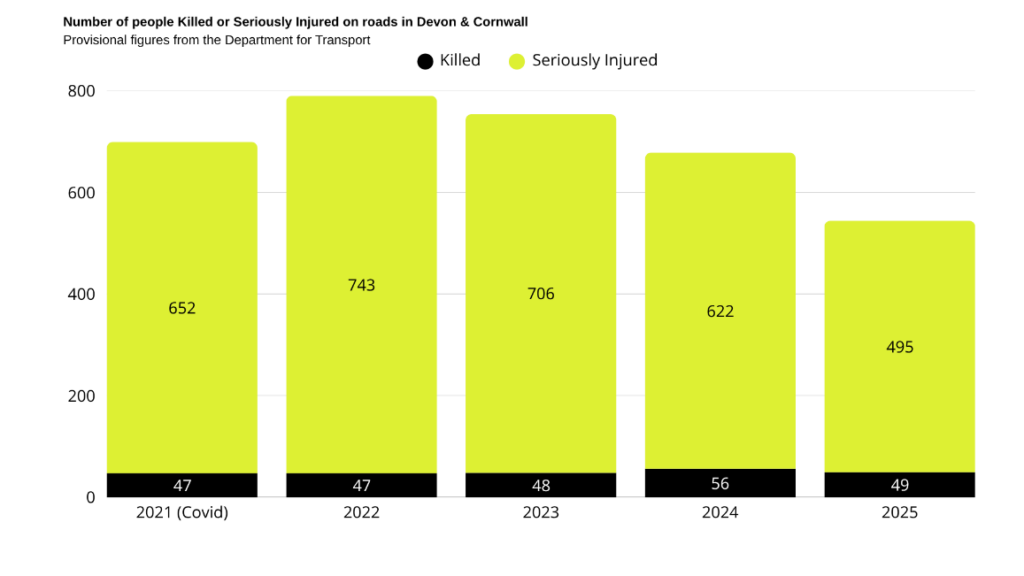
Provisional figures* from the Department for Transport (DfT) show that in 2025, 49 people were killed and 495 seriously injured in collisions in Devon and Cornwall. This is the lowest number since modern recording systems were introduced** and almost 20% lower than the figure for 2024.
The provisional data also shows the number of KSI*** collisions in the region have decreased every year since 2022 (post-Covid), demonstrating a significant reduction.
The graph below shows the KSI figures over the past 5 years:
Serious injuries include things such as head injuries, broken bones, loss of limbs and cuts or lacerations.
The release of the figures coincides with the fifth anniversary of the Vision Zero South West road safety partnership, a collaboration between 17 organisations across the region – including Devon & Cornwall Police, Devon and Somerset Fire and Rescue Service, Cornwall Fire and Rescue Service, South Western Ambulance Service Trust, local authorities, NHS Trusts, air ambulance charities, National Highways and the Office of the Police and Crime Commissioner.
The partnership has committed to reducing fatal and serious collisions by 50% by 2030 – and these latest figures suggest this target is within reach.
In the five years since it became operational, Vision Zero South West has funded numerous innovative and impactful road safety projects in the region, including:
- A state-of-the-art motorcycle simulator to train young riders in hazard prediction
- A UK-first trial of AI cameras which detect seatbelt and mobile phone offences
- Pedestrian training for thousands of primary school children
- Groundbreaking research work from IMPACT: The Centre for Post-Collision Research, Innovation and Translation
- The purchase of a Ford Focus RS car to help promote road safety to a younger audience through social media
- Over £250,000 of community-led safety schemes through our “Call For Ideas” grant funding scheme
Alison Hernandez, Police & Crime Commissioner for Devon, Cornwall and the Isles of Scilly, is chair of Vision Zero South West.
Commissioner Hernandez said: “Our collective efforts – as partners and communities – to ensure road users are at their best are starting to make a real difference to people’s lives.
“While we are obviously delighted to see a significant decrease in the number of people being killed or seriously injured, there is still a lot of work to do.
“We must never forget what these numbers represent. These are real people killed in tragic and traumatic circumstances – loved ones and family members, parents and children, brothers, sisters and friends.
“This is why road safety has always been a personal priority since I took office in 2016 – and why I helped set up the Vision Zero South West partnership.”
Commissioner Hernandez said every member of the partnership is passionate about saving lives and preventing injury on our roads.
She added: “We have worked tirelessly towards reducing these figures. This has involved embracing innovation and technology, being bold and trying new things, being relentless with our safety messaging and campaigns, and investing in things we know make a difference.
“Working in partnership has been absolutely key to every success we’ve had and I look forward to continuing this work with our partners in the future.”
Adrian Leisk, Head of Road Safety for Devon & Cornwall Police said: “This very welcome news demonstrates the effectiveness of the partnership approach to reducing the number of people killed or seriously injured on our roads.
“This also reduces the attendant trauma that it causes to the families and friends of victims and also helps to reduce the massive disruption that the aftermath of serious collision causes to transport, business, and individuals.
“Whilst this reduction is encouraging, our thoughts very much remain with those who have lost loved ones in a road traffic collision.
“Devon & Cornwall Police officers work tirelessly year-round to enforce the laws that are there to keep all road users safe. We are beginning to see that enforcement, notably around excessive speed, mobile phone, and seat belt offences, and in tandem with lowered speed limits and safety camera installation, is beginning to have a measurable effect on improving safety on our counties’ roads.”
So what kind of projects does Vision Zero South West actually fund? Here are a few case studies…
Walkability – Child Pedestrian Training Programme
The Walkability programme, funded by Vision Zero South West, is a child pedestrian training program which sees road safety lessons delivered at primary schools across Devon.
Offering valuable practical and theoretical skills to pupils aged 7-11, the program has so far been delivered to more than 6,000 pupils at 77 schools.
Road safety is not a statutory part of the national curriculum, but Vision Zero South West feels strongly that every child should receive some formal training to help them stay safe on and around roads.
Emily Moore, Walkability Project Coordinator with Active Devon, said: “Walkability gives pupils knowledge of the Green Cross Code, what certain road signs mean and how to identify safer places to cross the road.
“The aim of Walkability is to see fewer pedestrian casualties among children and improve their safety when they are crossing the road. It really lays the foundation for safe pedestrian practices, and we hope to see this lead to more children walking to school, and in their free time.
“We are really grateful to Vision Zero South West for commissioning and funding the project and for making Walkability the success that it is today.”
Vision Zero South West also funds pedestrian training programmes in Plymouth, Torbay and Cornwall.
Learn2Live
Funded by Vision Zero South West – and presented in partnership by the emergency services and local authorities – Learn2Live visits around 18 venues and reaches over 8,000 students every year.
James Warner of Devon & Somerset Fire and Rescue Service said: “Young drivers and passengers are one of the highest risk groups on our roads and are sadly overrepresented in our killed and seriously injured (KSI) figures.
“This is due to a combination of factors including inexperience, peer pressure, fatigue and risk taking.”
“Attending a Learn2Live presentation increases the safety of participants by raising their awareness of the vulnerability of new drivers and passengers to a range of unsafe activities while in a car.”
Brake victim support service
Vision Zero South West has funded additional caseworkers to be employed within Brake’s National Road Victim Service.
These caseworkers provide practical and emotional support to individuals and families who are bereaved or suffer life-changing injuries following road collisions.
Since 2023, when the funding was awarded, more than 300 referrals have been made to Brake caseworkers in Devon and Cornwall.
The funding enables more face-to-face contact between caseworkers and families, improving the quality of support they receive.
The service has just received funding for a further two years from both Vision Zero South West and the Office of the Police and Crime Commissioner for Devon, Cornwall and the Isles of Scilly.
Commissioner Hernandez, Police and Crime Commissioner for Devon, Cornwall, the Isles of Scilly and chairman of the Vision Zero South West road safety partnership said: “Working in close collaboration, our partnership has made a commitment to reduce the number of people killed and seriously injured on Devon and Cornwall’s roads – initially by 50% by 2030, and eventually to zero. “Until then, we have a moral duty to support people whose lives are turned upside down by the devastating consequences of collisions on our roads.
“While no one ever expects to be affected by a road traffic collision, it is some comfort to know that we have practical, emotional and therapeutic services on hand to help those people and offer continued support during their time of need.”
IMPACT: The Centre for Post-Collision Research, Innovation and Translation
IMPACT: The Centre for Post-Collision Research, Innovation and Translation is one of the most important and groundbreaking projects funded by Vision Zero South West.
Post-crash care is a vital component of the Safe System approach to road safety, focused on reducing deaths and serious injuries through rapid, effective, and equitable response following a collision.
Vision Zero South West recognises that what happens after a crash can be just as important as what happens before it.
We are proud to fund pioneering work in this space — including research into barriers and enablers to administering life-saving treatments such as tranexamic acid (TXA) by trained professional bystanders.
A key partner in our work is Professor Tim Nutbeam, a consultant in Emergency Medicine and Prehospital Critical Care at Plymouth Hospitals NHS Trust and Devon Air Ambulance.
Tim leads IMPACT – the Centre for Post-Collision Research, Innovation and Translation — a Vision Zero South West-funded initiative dedicated to transforming post-crash response.
IMPACT works across the full Post-Collision Chain of Survival, from early recognition and rescue at the scene through to hospital care and rehabilitation, using research, innovation, and practical translation to improve outcomes.
IMPACT remains at the forefront of improving systems, supporting other researchers, and ensuring that those injured on our roads receive the best possible care — whoever and wherever they are.
* Provisional figures remain subject to further validation. These can change as collision investigations progress and conditions are updated.
** Injury Based Reporting Systems (IBRS) were introduced in 2015 in Devon & Cornwall. The DfT only reports figures from 2014 onwards. For more information visit: Guide to injury-based reporting and severity adjustments for road casualty statistics – GOV.UK
*** KSI stands for Killed or Seriously Injured and is a key data point used by the Department for Transport. For more information about the classification of injury severity, please visit: Guide to severity adjustments for reported road casualties Great Britain – GOV.UK