
Every year, thousands of families across the UK are affected by road traffic collisions. In those critical moments after a crash – the first recognition of injury, the first person to call for help, and the first clinical decisions – outcomes can be shaped in minutes, or even seconds.
But despite the huge impact of these early moments, we still don’t know enough about what saves the most lives, reduces long‑term disability, or ensures people fully recover. Different emergency services often lack shared data, national guidance varies, and some life‑saving questions simply haven’t been researched.
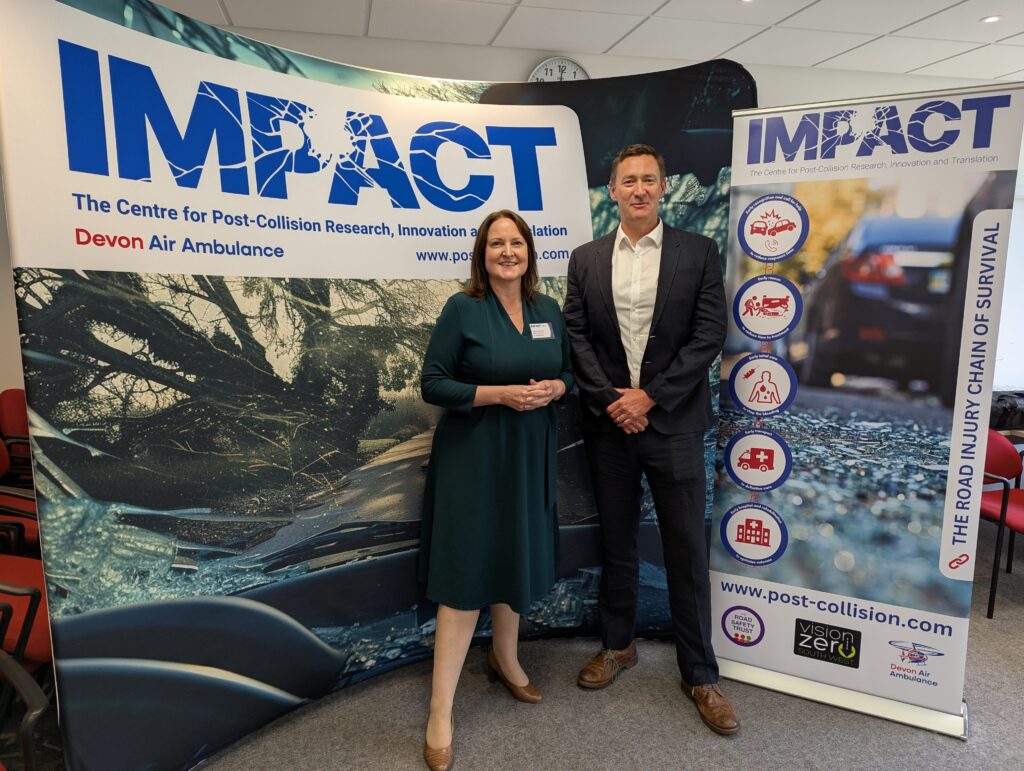
That’s why this new UK-first Priority Setting Partnership (PSP) was created by Impact, Devon Air Ambulance’s post collision research unit – which is funded with support from Vision Zero South West.
For the first time, people with lived experience of road injury, including survivors, families, and bystanders, worked directly alongside paramedics, clinicians, police, fire and rescue teams, researchers and charities to agree the most important unanswered questions about post‑collision care.
The resulting document has been shaped by the people who’ve been there and by those who respond day to day to these kinds of incidents.
The PSP has produced a clear, publicly validated Top Ten research priorities focused on the things that matter most in those crucial moments after a collision. These cover a range of themes:
- spotting life‑threatening injuries sooner
- speeding up safe rescue
- strengthening coordination between emergency services
- making better use of technology and vehicle data
- improving dispatcher tools
- supporting bystanders to help confidently
- tackling inequalities
- and defining recovery in a way that reflects what patients say matters most.
The research priorities give the UK a blueprint for smarter research, better investment and more consistent care across the country.
Tim Nutbeam leads Devon Air Ambulance’s IMPACT research unit. “A UK first: this PSP is the first UK Priority Setting Partnership focused on road injury and post collision care, providing a roadmap for research and system improvement,” he said.
“The Priority Setting Partnership was made possible through funding from Transport Scotland and Vision Zero South West, and the PSP process was delivered in partnership with the Faculty of Pre‑Hospital Care (Royal College of Surgeons of Edinburgh). The report brings together people with lived experience of road injury alongside emergency responders, clinicians, researchers and charities from across the UK, and sets out a shared Top Ten research agenda to improve outcomes after road traffic collisions.
“This emphasises early recognition, rescue, and initial care, where timely action can change outcomes. Systems that support positive outcomes around oordination, data flow, and decision support relating to dispatch, scene and vehicle data are central themes in the priorities.
“It also highlights the importance of equity and recovery to ensure patient‑defined recovery outcomes cut across the agenda and are embedded in future work.
“This is a timely and ground-breaking first step for the UK and Devon Air Ambulance in publishing this report in the same year as a new DfT Road Safety Strategy, to ensure it’s embedded in national policy.”
Dr Andy Smith, Chair of the Faculty of Prehospital Care at the Royal College of Surgeons, Edinburgh, said: “This report is the result of genuine collaboration; patients, responders, clinicians and researchers working toward a common goal. The Faculty of Pre-Hospital Care is proud to have been part of that process. When the right people share the same table, the work that follows can save lives. The Top Ten research priorities identified are proof of that.”
Alison Hernandez, Police & Crime Commissioner for Devon, Cornwall & The Isles of Scilly, and Chair of Vision Zero South West, said: “Our partnership is committed to reducing the number of deaths and serious injuries on Devon & Cornwall’s roads – and post-collision care is vital in this ambition.
“We are extremely fortunate to have such experienced and passionate clinical practitioners involved with IMPACT and based right here in Devon.
“Their groundbreaking work has already led to changes in national guidance around casualty extrication from vehicles and their ongoing work in the post-collision field is both exciting and important.
“Vision Zero South West is delighted to support this amazing work, which we are certain will have major positive implications for road safety in the future.”
More information can be found on IMPACT’s website: www.post-collision.com/ road-injury-priority-setting-partnership.